I used to say that if you can read, you can cook. You may not get a spot on Top Chef because you can make one of RR’s 30-minute “sammy” recipes (gag), but you can at least feed yourself. Follow the recipe, pay attention to the details, and you can make food. Well years of successes and failures later, I realize that isn’t entirely true. There’s a whole foundation and body of knowledge that you have to build on. Sure, you can mix butter and sugar together, but knowing just the right degree of butter softness that will turn out a soft, golden sugar cookie with crispy brown edges? That’s experience. So the recipe says to roast your chicken for 30 minutes – you can do that! But you have to be able to eyeball it and/or poke it with your finger and just know that it’s not quite done. Maybe the cutlets the cookbook author used were half an inch thick and yours are closer to three-quarters. Maybe your oven has an uneven cool spot or you didn’t preheat long enough. Sure there are tips and tricks, fool-proof recipes, one-pot meals, thermometers and scales, but knowing HOW to cook isn’t quite the same as following a recipe. Am I an expert? No. I’m a student – I read non-fiction books about butchery, flour protein content, the Maillard reaction, and the history of garlic. I’m a lot of fun at parties, let me tell you. I mentioned to a friend recently that I’d treated myself to a spree at Penzey’s, and she asked what that was, and why. It’s hard not to be boring sometimes.
But sometimes you can read a recipe, and just know it’s not going to work. No, you can’t caramelize those onions in fifteen minutes. No, a two hour braise for short ribs will not give you fork-tender meat. Half a cup of lemon juice will be too lemony. That’s knowing HOW to cook. And today, I’m making a recipe that I’m pretty sure isn’t going to work out too well. Why? Well I found this pizza book on www.thriftbooks.com (awesome site – highly recommended) that has recipes for so many different styles – Scacciata, Sfincione – do you know how hard it is to find a recipe for sfincione? I mean one in English? It’s called, simply “The Pizza Book” by Evelyne Sloman, and I need to test it to see if she’s got the goods.

So today we get back to the basics with focaccia, or pizza bread. Focaccia is sold all over Italy plain, or lightly topped with olive oil, salt, herbs, and maybe just a sprinkle of cheese. No sauce, no stringy lumps of mozzarella, no meats or vegetables. Just some good bread wrapped in a piece of waxed paper.
Red Flag #1: This book does not specify what type of flour to use. It calls for one batch of either their Basic Pizza Dough, or Sicilian-style Dough. Why either? Wouldn’t one or the other be better? What do most people use? I choose the Sicilian-style dough. It’s a good, simple dough with basic ingredients:
3 cups flour
1 cup of water (110 degrees)
1 packet active dry yeast
¼ cup olive oil
½ teaspoon salt
All good things. Nothing funny – no sugar, honey, cornmeal or cinnamon. No red flags here. This recipe also calls for hand mixing and kneading. More work in the long run, but then I don’t have to disassemble and wash all the various parts of my KitchenAid. Add the yeast to the water and stir lightly until it dissolves. Add one cup of flour and the olive oil and salt. Mix with a wooden spoon.

I like mixing by hand, even though it’s tough. I like the wooden spoon. I feel authentic. Add a second cup of flour and continue. It’s getting thick. Turn the dough out onto a floured surface and start kneading in the third cup. This is fun. This is cooking. Kneading dough is physical and satisfying. Five to ten minutes of kneading will develop the gluten and count as my workout for today. This comes together nicely and looks like I’m pretty sure it should.

It goes into a lightly oiled bowl, gets flipped to oil the whole surface, then gets covered tightly with plastic wrap. It goes into the oven, which I turned on for two minutes, then turned off. This will create a warm proofing box that will not cook the dough or melt the plastic.
Red Flag #2: This calls for a 30 to 45 minute rise. Remember once we talked about long fermentation and flavor development? Peter Reinhart may have let me down with his American style pizza, but I did learn a thing or two about yeast doughs. 30 to 45 minutes doesn’t seem quite long enough. I fear this will taste like raw flour.

But 45 minutes later, the dough is ‘riz – I’m sorry the picture doesn’t adequately show how ‘riz it ’tis, but it’s doubled, I promise. Punch the dough down – literally – to release the gases quickly. See the mark of my tiny fist of fury?

Turn the dough out onto a clean surface (heh – I don’t have many of those) and knead for one more minute. This takes it from light and spongy to a denser, dough-like texture. Aren’t I a good writer? I just described the dough as “dough-like”. Call Mr. Pulitzer and tell him I’ve got it in the bag! Ignore the fact that this post is way too long, too rambly, and too unfocused for anyone but the most dedicated reader to follow. Ignore the fact that I keep making up words like “rambly”.
Red Flag #3: Preheat the oven to 400. This doesn’t seem high enough to me. High fast heat usually works best for pizza. It also doesn’t mention where to position the oven racks, or if I should use a pizza stone. I guess – middle rack, no stone. Press the (now quite stretchy and resistant – nom, nom, gluten!) dough into a lightly oiled pan dusted with cornmeal (aha!). She recommends a variety of strange sized pans I do not own (12-inch round or 15-inch square). I use a regular old sheet pan, well seasoned (gross-looking) from years of love.
Red Flag #4: No dimpling. Focaccia has a hilly, bumpy texture on top, so I dabble at it with my (clean) fingers. Brush with olive oil.

See? SEE how the oil pools into the dimples I made? That’s going to taste better!
Sprinkle with coarse kosher salt, which I finally, finally locate at the very back of a very top shelf behind an ancient bottle of vanilla that has welded itself to the shelf surface. I ignore the recommendation of adding garlic slivers, because this is a back-to-basics kind of day. Bake for 35 minutes. No high fast heat here!
And here we are:

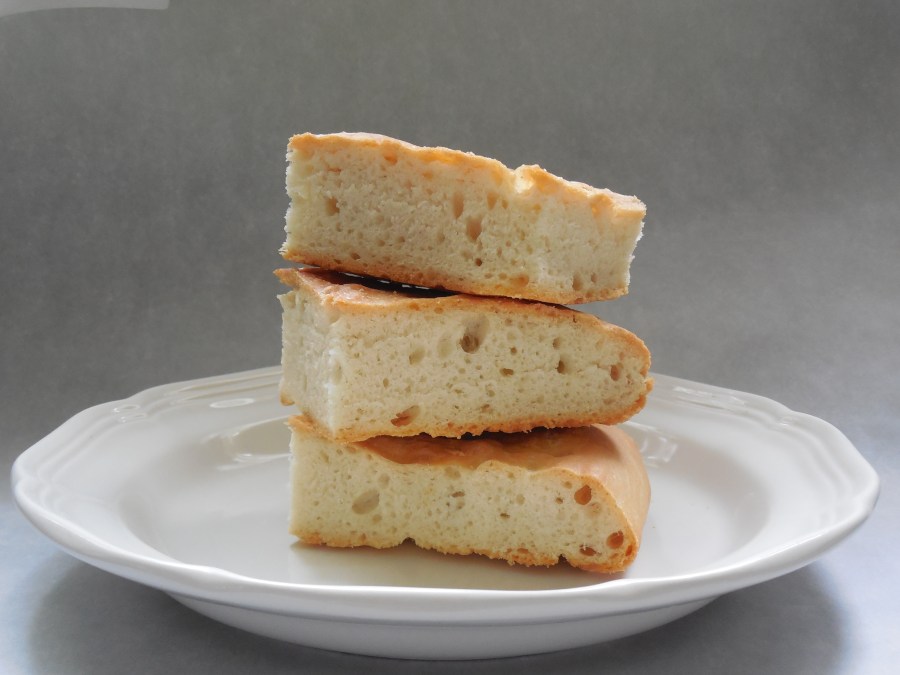
It looks…nice. It doesn’t quite look like focaccia. When I cut it, it’s obvious that something went wrong. The outside is crispy, the inside is bread-y. It’s not the dense, moist, chewy bread I was expecting. The olive oil pools have dried up. This is just. Well, it’s just bread. It’s not bad – the flavor is nice and I’d be proud to serve this to guests, but I wouldn’t call it focaccia. I just made some bread. I’m going to skip the triumphant “Here it is!” picture I usually end with. Again, I’m no expert, but now I’ve learned something new to add to my body of knowledge. Unfortunately the thing I learned was not how to make focaccia.
Edited to include: a triumphant “Here it is!” picture. I have the good fortune to work with a lovely young lady who studies photography and kindly offered to explain what was wrong with some of my food pictures. Let me tell you this – she tore me a new one, as I am apparently doing everything wrong one can do with a photo. Good food photography is Liberace tinkling up and down a grand piano, performing flawless arpeggios. My food photography is the equivalent of a not-terribly-bright child pounding on a toy xylophone with chubby fists. I was unsurprised by this revelation, but she kindly offered me some tips, which I decided to play with. Here is a not-terrible picture of my finished product.


 illdothedisheslater