“Can you make goat cheese with evaporated goat milk?”
“Can you make goat cheese with powdered goat milk?”
“Can you make chevre with evaporated goat milk?”
“Can you make chevre with powdered goat milk?”

Guys, Google has failed me. These are only a few of the hundred things I typed into the search bar trying to answer this age-old riddle. I’m including the obvious searches in case anyone else in the English-speaking world has wondered the same thing. The only bits of info I could find said mostly “No”, but also mentioned they’d heard it could be done. So today I’m going to do the legwork and let you know. Go back and check out my state-milk-laws rant if you want, but I’ve said it all before. Unless you have goats, know someone with goats, or have incriminating evidence about someone with goats, you can’t get good raw or lightly pasteurized goat milk here. It’s Meyenberg UP or nothing. I tried, half-assedly, to get something cheesy going with that once, and it turned out…not so well. It looked like cheese, it smelled like cheese, but it tasted like a goat’s ass. (I assume. I have no personal experience in the matter.) Also I apologize for my absence last week – it was my birthday and instead of effing up some new fancy recipe, I decided to make and eat a large pot of meatballs.
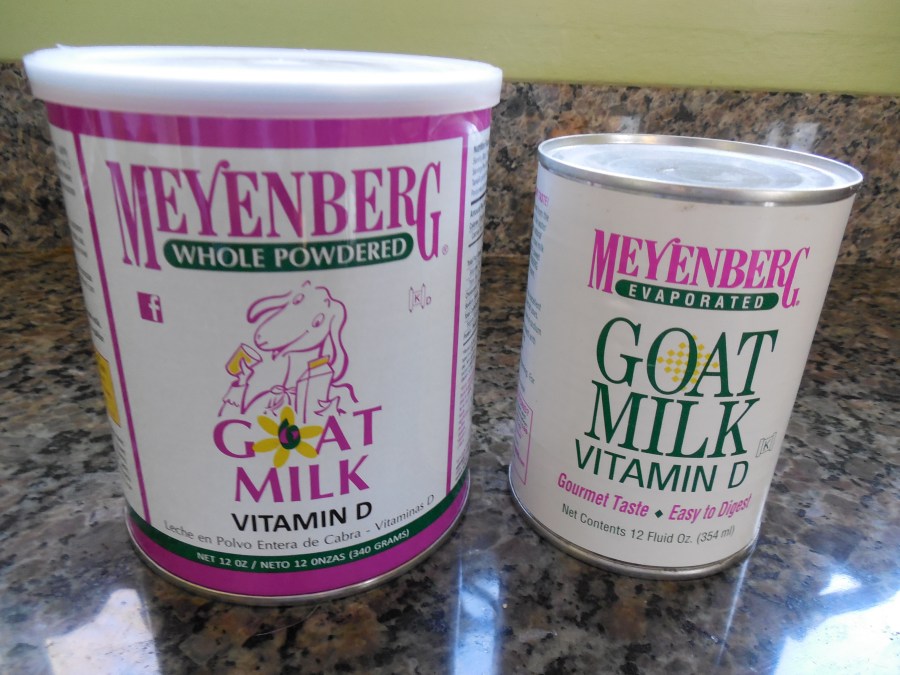
For the purposes of this experiment, I have two types of goat milk products – Evaporated Goat Milk and Powdered Goat Milk.
I’m going to make these the same way, partially following a couple different recipes, and also using my own keen instincts since that’s guaranteed to work right? I mean I’ve already made cheese like four times so I’m practically an expert.
The problem with ultra-pasteurization is that the caseins (milk proteins) get heated so much they lose their integrity. Homogenization further squooshes them into submission to prevent curds from forming. Science, y’all! I assume that in the powdering and evaporating processes, that the caseins are not treated too gently, so I’m going to use half reconstituted goat milk and half heavy cream from the stinky health food store – hoping for the healthy caseins to give me some hot curding action, and the goat milk to give me that great chevre taste. So here I have two quarts of heavy cream (and I mean heavy – you think that little cardboard carton from the grocery has heavy cream in it? This stuff is thick.) Also the mesophilic starter culture, rennet, and calcium chloride, which I’m adding to encourage firm curds.

Also? To be honest I’m about 90% sure this will not work.
First I have to reconstitute the milk. No, first I clean the counters, pots, utensils, stovetop, and my hands, blah blah blah. Then I add 8 tablespoons of the powdered milk to one quart of warm water and whisk.

It’s chunky and unpleasant looking for the most part. Eventually the powder dissolves and it kind of looks like milk!
The evaporated milk…is beige. A really unattractive tan color.

I soldier on, adding equal parts water. I also add a quart of heavy cream to each bowl and stir thoroughly. Fortunately the beige-y color is gone at this point.
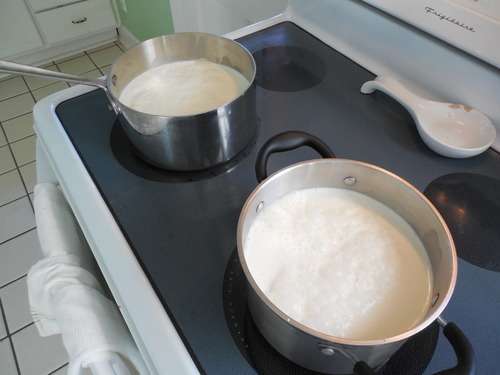
Then it’s simply following the usual steps for goat cheese making. I heat the milk to around 87 degrees, stir in 5 drops of diluted calcium chloride, then 1/8 teaspoon of mesophilic starter culture, then two drops of rennet to each pot. Note: I have lost my small bottle of starter culture, and only have this weird little packet. I divide it into two equal piles using cocaine-cutting techniques I have gleaned from the movies.

Each pot gets covered and set aside to sit for 24 hours while I keep my fingers crossed and try not to poke it.

I really want to poke it. Stay tuned.

 illdothedisheslater