
Earlier this week I casually leaned against the door to my boss’s office and heard myself say, “Actually the history of American Cheese is pretty interesting.” before I saw a moment of panic light in his eyes. I quickly stopped the conversation so as not to get fired. He’s politely interested in my cheesemaking, but not THAT interested. No one wants to hear me talk about American Cheese at length. So – American Cheese you guys. I’m going to talk about it at length.
The dumbest, least impressive cheese you can imagine. But have you ever made it? Well prepare to be impressed. I know American Cheese isn’t going to knock anybody’s socks off, but it’s still cheesemaking, kind of. See American Cheese isn’t legally called cheese. Since it’s not made with the traditional process of curds and whey, rennet, or mold, it has to be called “processed cheese”, or “cheese-food”, or “cheese product” or you may be more familiar with it as “singles”. In Canada, it’s called Canadian Cheese! It’s generally made of a blend of milk, milk fat, whey protein, and a zillion other laboratory creations.
The history can be a little murky, but it seems to have been born in the early 20th century, and quickly popularized by one Mr. James L. Kraft who provided a less expensive alternative to cheddar. American cheddars were wildly popular at that time – Wikipedia informs me that in 1878, the total amount of cheese exported from the good ol’ USA topped 355 million pounds. The British couldn’t get enough of our wonderful stuff. When WWII came along, the government temporarily restricted cheese consumption to conserve American agricultural resources – sale or consumption of any type of cheese other than American Cheese was banned on May 4, 1942, then the ban was lifted less than three months later. I assume patriotism only goes so far, and the nation ran around waving their collective arms over their heads, screaming for Cheddar, Gouda, and Parmesan until the government just couldn’t hear itself think. But as usual, I digress.
No, there’s nothing fancy about American Cheese, but it’s the cheese of our childhoods, and I want to learn how to make it. Why? I don’t know. The Kraft Singles are just fine, but I don’t like the Velveeta-ish squeaky feeling or the knowledge that it’s just a bunch of chemicals. I like chemicals, but not that much. I follow the recipe from America’s Test Kitchen’s DIY Cookbook, which calls for the following:

12 oz. Colby Cheese, finely grated
½ cup of whole milk + 2 tablespoons (I bought 2% by accident, but I think it’ll be okay)
Cream of Tartar – that thing that lives in the darkest corners of your pantry until you need to make meringue
Powdered Whole Milk – special order only. Groceries only carry non-fat, and I am not a non-fat kind of person. Apparently non-fat powdered milk adds off-flavors to the finished product.
Salt, of course.
Unflavored gelatin – the idea of making unflavored Jell-O, for some strange reason, is hilarious to me.
Now I don’t have as many pictures as I’d like, because this is a frenetic, frenzied thing to do – you have to work fast and accurately to get the texture right. So bear with me while I dash back and forth like a squirrel.
First I prepare my “mold”, which is a disposable aluminum loaf pan lined with plastic wrap.

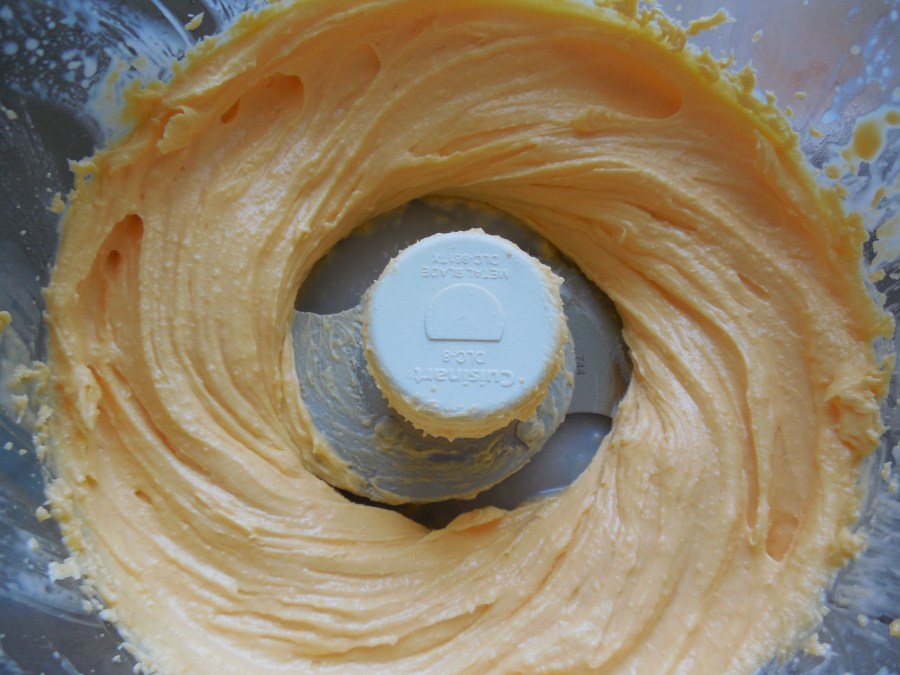
Then I grate the cheese in my food processor, and add the powdered milk, salt, and cream of tartar. Sprinkle the gelatin over one tablespoon of cold water and let it gel for about five minutes. Then heat your milk to just when it starts to boil. Acting quickly, whisk the gelatin into the milk, and pour into the running food processor before it can cool. This creates an unhealthy amount of stress in my life, but thankfully only lasts about ten minutes. Let it whir – the hot milk melts the cheese and you can watch it get creamy looking. This is fun, as I can watch and see that it’s working – I’m doing it, I’m doing it!

Yep, It’s gross.
Now while it’s still warm, I have to transfer it to my mold. Immediately I realize I’ve chosen a loaf pan that’s way too big and have to stop and scramble. I find a mini-loaf pan and rejoice. Ten seconds into spatula-ing the cheese mixture in, I give up and reach for the rubber gloves, which work much better.

Pack the cheese into the mold and wrap it tightly with plastic wrap. Let it set in the fridge for at least three hours so the gelatin and cream of tartar can do their work.

Three hours later….

Cheese! I did it! And here’s the amazing part – it tastes like American Cheese. There’s no plastic squeak, and it’s maybe a bit more grainy in texture, but it pretty much tastes just like really good American Cheese. I use the classic trick of slicing soft cheeses with dental floss – it’s just a tad too soft for a knife, but the slices hold together.
Well the dishes for this are epic – the food processor alone has four parts and I’ve also used three out of four blades with it. The milk pot, the gelatin bowl, the cutting board, and on and on. But I get another tick in the win column. I am a rock star.

 illdothedisheslater