Guys, I’ve got to take a break from these all-day projects. As much as I love the cooking and dishwashing, I need an easier recipe that will allow me to leave the house for more than thirty minutes at a time. So today it’s carnitas. I got very interested in slow cooked pork after a meal in Charlotte, NC at a Mexican restaurant called Cantina 1511. My husband ordered the burritos barbacoa, and the meat inside! Oh my! I can’t begin to describe it! It was tender, spicy, and full of rich porky smoky flavor. I can’t begin to aspire to that level of porkiness. Or can I?
I first e-mailed the restaurant asking for tips, and expecting no response at all. To my surprise, the head chef, Vince Giancarlo answered my e-mail personally. (A fellow eye-tie – I should have expected as much!) While he didn’t give me the exact recipe (duh), he shared a few tips and I have put them to good use. To start, buy a piece of pork the size of a smallish Toyota (Tercel, Corolla, etc.):

This is a Boston Butt. Despite the hilarious name, it’s actually taken from the pig’s shoulder. It is also called the Shoulder Blade. This baby weighs in at over fifteen and a half pounds, and is covered all on one side with a half-inch fat cap (which is omitted from the photographs because it is gross. And delicious. Grolicious.) The actual butt will give you hams. I must once again remind my faithful readers that I am not a crazy person (despite ample evidence to the contrary), and will not be cooking this entire mess at once. It comes in a package with two pieces, and one is wrapped and frozen for future consumption.
Can I take a minute to bitch about grocery store pork? Unless you’re careful, what you get nowadays is “enhanced” pork. This means they have injected it with up to a 12% solution of water, salt, and sodium phosphate. So any pork you buy, mentally subtract 12% of meat, or add 12% to the cost – you are buying salt water. Why? Allegedly this makes the meat more tender and flavorful. Breeding practices over the last 50+ years have given our society a very lean pig, that is to say not much fat. Fat is bad. Fat is the enemy. But by giving up our precious fat, we are also losing a lot of flavor and tenderness, so you brine, you season, you salt. And all of these things are great, but somewhere along the line grocery stores have decided to do it for you which, in my opinion, ruins the meat. “Enhanced” pork is tender, sure, but the flavor and texture is all wrong. There’s a sliminess to the meat, and a chemically aftertaste that I can do without. My local grocery now has a new brand that does not have any of these “enhancements” and, predictably, costs twice as much. I cannot stop using sarcastic quotation marks around “enhanced”. I really can’t. My solution is to buy all my pork at Sam’s Club – hands down the best meat in town (outside of our local family-owned butcher shop where the service can’t be beat, but the prices sure can). Okay – rant over.
Since this is “my” recipe, I will try to include specific directions and ingredients instead of my usual color commentary. Cut the meat into two inch cubes, trimming off as much fat as you can. You will not be able to trim off all the fat, nor should you. Big white chunks? Silverskin? Lose ‘em. Keep the veiny layers of fat between the meat. When cooked correctly, this fat will melt away, leaving tender, flavorful meat. This process is also graphic and upsetting for those unused to the butchering arts. (Recommended reading: Cleaving by Julie Powell, the author of Julie and Julia. I enjoyed the graphic descriptions of butchering, but did not enjoy the graphic descriptions of adultery. Spoiler!)

Throw in some spices. How’s that for direction? I add black, cayenne, and crushed red pepper. I add some garlic powder. I add a generous amount of salt, and a splash of liquid smoke (which is NOT the lab-created Franken-condiment you may believe it to be). Add whatever you like, but I’m aiming for a Mexican-ish spicy dish that mostly tastes like…pork.
Forgive me for the “some” quantities – measuring specific amounts creates more dishes to wash, and the level of spiciness is up to you. I like spicy enough to require a couple beers, but not so spicy that I get red-faced and teary. I like the taste of pork and don’t want to bury it under macho heat.

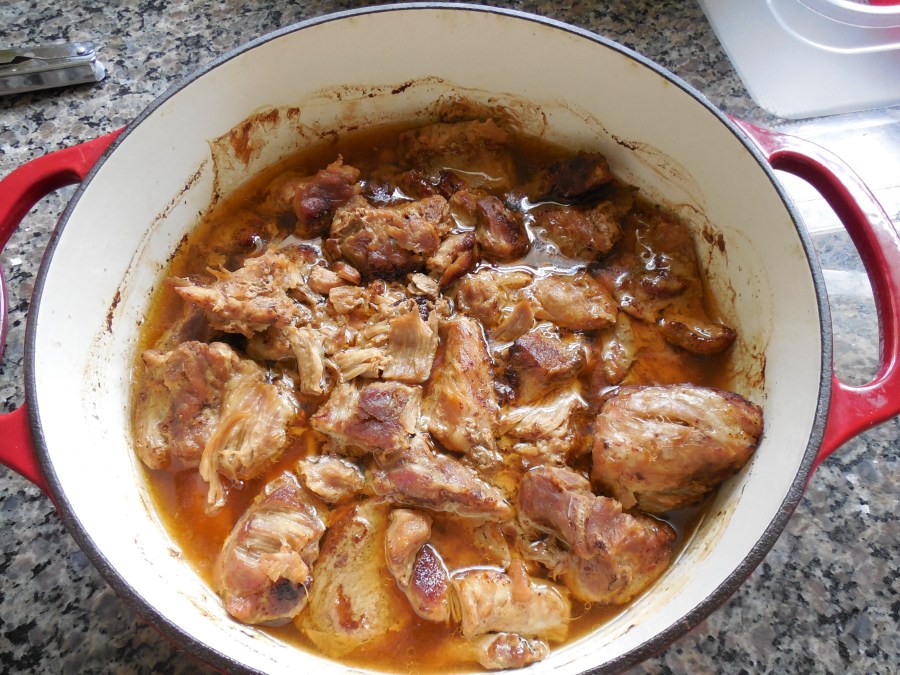
Throw it all in a pot, and fill up with water until it just barely doesn’t cover the top of the meat. Put this all in the oven at 300 degrees, and go out into the world and live your life. Actually don’t – you should never leave the house while the stove or oven is on (or washing machine, TV, hair dryer, etc.) But that’s pretty much the bulk of this preparation – let it cook slowly for a longlonglong time. Once the pork is cooked through (2 to 3 hours) you can turn the oven off, let it sit in there, and go shopping or whatever. Turn the oven back on when you come home. (Note: Do not rely on me for food safety advice. Meat probably shouldn’t sit around cooling in an oven and generating bacteria. BUT I have not died from pork. Yet.) This particular pot cooked for around 5 hours when I turned my attention back to it.

See? Seeeee??? No fat left. No chunks of gristle, no chewy fatty bites. Just delicious, tender, spicy pork. Piles of it. Pounds of it. Get in there with some tongs and shred it a bit – not too much – you still want chunks and hearty bites.

Now you can do anything you want with it! One of my favorite dishes is simply on tortillas with cheese and lettuce. Traditionally, carnitas are fried in lard, but I don’t see adding another step here. The meat is moist and tastes like heaven.

The leftovers will provide fodder for days – get creative. You can pour canned tomato sauce over about two cups of pork and get a rich, thick sugo that is fantastic with rigatoni or mostaccelli. You can dump some barbecue sauce in it. You can throw it on a salad if you’re one of those people. I am not.

 illdothedisheslater