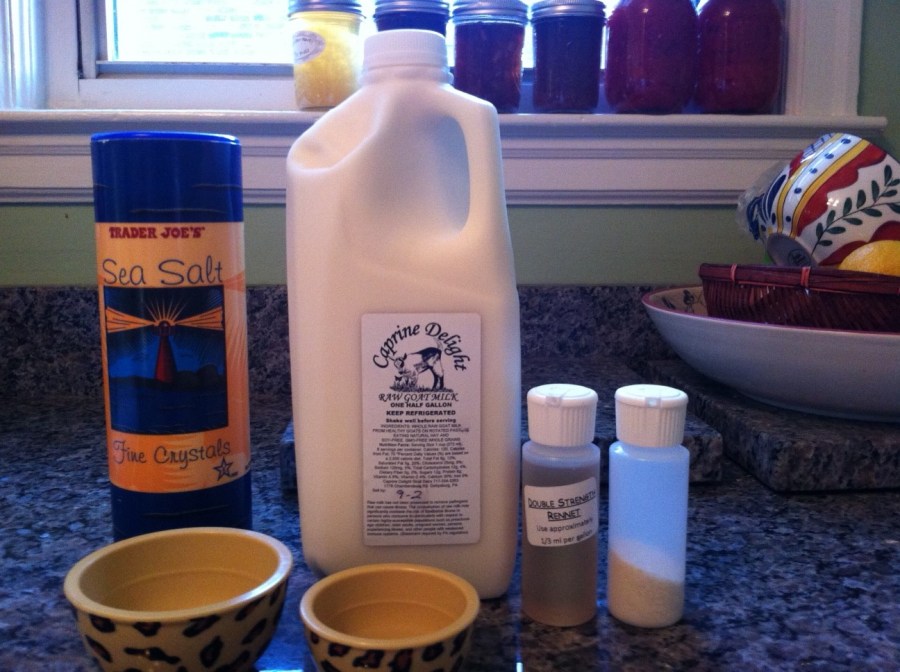
This has only five ingredients. How hard can it be?
Answer: Huh.
I began searching for goat’s milk almost a year ago. My state has some of the strictest laws in the country pertaining to raw milk. I called goat cheese companies, hung around the farmer’s market unsuccessfully trying out different magic words on the dairy booths, and eventually formed the opinion (which was confirmed by a college agricultural professor) that I could probably get my hands on some heroin before any fresh, local goat milk would wind up in my kitchen.
I even found a cheesemaking supply shop only 5 miles from my house. They happily supplied me with liquid animal rennet and mesophilic starter culture, but to get the milk I’d have to get some goats.
I’m not getting goats. My home houses a geriatric cat who sleeps 23 hours a day, an extremely anxious dog, and a very tolerant husband who nevertheless has his limits. I work 40+ hours a week, and I don’t want to spend time worrying about noise complaints, hoof trimming, or a goat stampede taking out a smaller mammal that lives in my house.
Months went by as I cast longing glances at the lonely supplies living in my fridge.

When lo! My brother, driving back from New York City, offers to stop and buy me some milk if I can find a store that’s not too far off his path. A quick Google search (and some input from my Chowhound buddies) finds a store in Pennsylvania – a state that allows raw milk sales on a retail level. Hurrah!
By the weekend, I had four of these babies living in my fridge.

From here it should be easy as pie. I assembled my ingredients: goat milk, rennet, culture, water, and salt.

To be honest I had to retake this picture because I realized I had a gross tomato rotting on the windowsill next to the picturesque jams and honey. In the interest of full disclosure, here’s the original shot.

Gross.
So to begin, you heat the milk very slowly to 90 degrees. That thing sticking out of the pot is a remote thermometer.

Sprinkle the culture across the top of the milk and stir in gently. Add a couple drops of rennet to a tablespoon of water and stir in gently. Cover pot and let it rest undisturbed for 12 to 24 hours. Do not poke it. You will want to poke it. (I poked it.) You will peek under the lid every 15 minutes for the first hour or so in case cheese magically appears. This quickly gets boring and you can go about your day. The next morning – holy cow! (Or holy goat, I suppose.)

Curds and whey! Just like you’ve read about. There is a thin layer of liquid sitting upon a solid disc of curd. It worked! (Maybe.) The next step is to carefully ladle the curds into a colander lined with butter muslin (which no store carries, anywhere on earth) or several layers of cheesecloth. You do not have several layers of cheesecloth – you have one lonely square about the size of a paper towel. It’s 7:30 a.m. on Sunday so you have to go to Walmart. Cheesecloth, contrary to all common sense, is not in the cheese section, the milk section, the paper towel aisle, the kitchen aisle, or even in the cloth department. I finally found some in the arts and crafts aisle when I’d just about given up and was desperately wondering if cross-stitch cloth would work. It was that or bandages.

Apparently people use cheesecloth to make ghosts. Not cheese. Only ghosts.
Let the curds drain in the sink for a couple hours. Poke all you want! You will be left with alarming amounts of leftover whey, which I declined to taste or photograph. My friend Google advises that dogs love whey. I tentatively offer some to my dog. She loves it! Then gently dump the curds into a bowl and stir in one tablespoon of sea salt. The salt won’t come out of the shaker. The salt won’t come out of the shaker. Bang shaker on counter. It still won’t come out. Jam a kebob skewer into the shaker and jiggle it around. Catch salt on a piece of clean paper or whatever the hell you have handy at this point. I used a pizza coupon. Repeat for approximately five minutes. Double check the recipe – you only need a teaspoon. The remaining salt will not fit back in the shaker. It won’t fit. Still won’t fit. Recall sea salt was only $1.29 and you’ve barely made a dent in it. Throw away any extra salt.

Now comes the fun part! Lay down several layers of cheesecloth (four should do nicely) and spoon curds into a small pile. Gather the cloth up into a little hobo bindle and hang it over a bowl with more kebab skewers. At this point it is important to carefully frame your shots so that no one can see that your kitchen has gotten progressively messier over the last two days, what with the curds and whey sloshing around, the cat waking long enough to step in your salt pile, and having to fry a whole pound of bacon to make dip for a party last night. The dog will be all up in your business because now that she’s tasted whey there’s no turning back and she has unexpectedly gone all Trainspotting on you and wants more more more. Your husband will have retreated to the den for a marathon of Hard Knocks in order to stay out of the way and not deal with your particular brand of crazy for awhile.

Ease the bindle bowl into the fridge next to a chicken carcass, where it will continue to drain and begin to firm up over the next 12 to 24 hours. By now the smell of sour milk should be emanating from you in nearly visible stink lines. Proceed to the sink where a mountain of dishes awaits your attention. Dishes done, glance up at the clock to ascertain if it’s a reasonable time of day to fix a cocktail. Become dismayed when you realize it’s only 10:00 a.m. Shrug and head upstairs to the computer where you will discover that whey will make your dog’s urine highly acidic and worry briefly about the state of your lawn. Shrug again.

12 to 24 hours later, you will have a product that you could have purchased at Trader Joe’s for $5. Your cheese should have a firm but crumbly texture. I tried mine with some trepidation and mild anxiety. It’s good! It tastes like goat cheese! It is tangy and chalky and all the things goat cheese is supposed to be.
Was it worth it? Taking in equipment, mileage, and time spent, absolutely not. I could have spent 20 minutes in the car and $5 for essentially the same product. But damn – now I can say that I’ve made cheese. And it was good.
P.S. I lied. I still haven’t done the dishes.

 illdothedisheslater